

INTRODUCTION
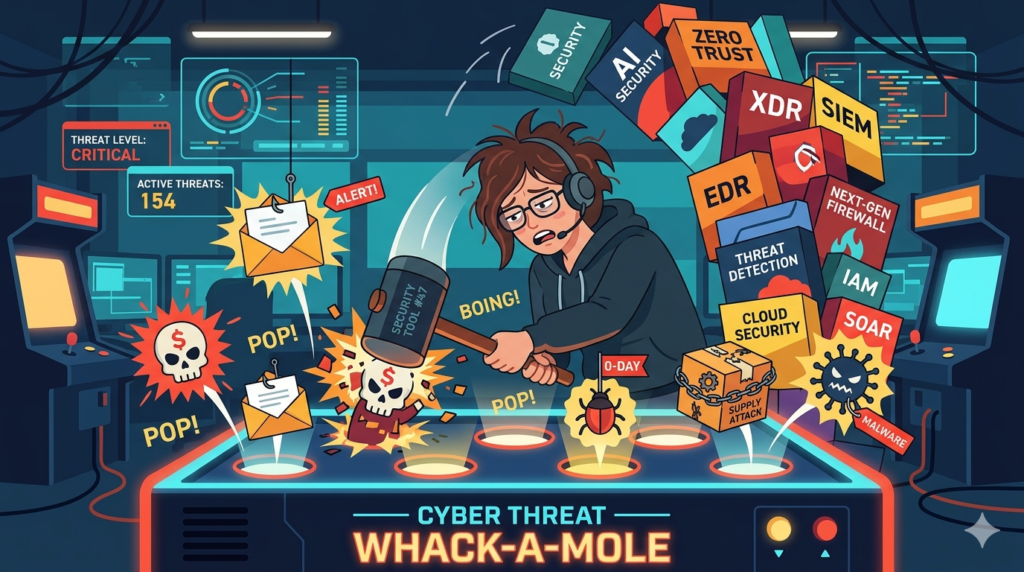
Think about astrology for a moment. Nobody can truly prove that Mercury in retrograde is responsible for your bad decisions, but the moment you ignore the warning and something goes wrong, well, suddenly the stars had a point, didn’t they? The cybersecurity industry operates on a surprisingly similar principle. No one can guarantee with absolute certainty that a specific threat will materialize, but if you choose to do nothing and something does go sideways, the consequences are very real and very expensive. That one asymmetry is enough to keep the entire industry running.
Here’s where the comparison gets interesting though, Astrology is optional, you opt in because you believe in it, or at least find comfort in it. Cybersecurity, on the other hand, isn’t really a choice anymore. In a world where your business, your data, and your reputation all live online, sitting it out simply isn’t an option. And the industry knows this. It leverages that combination of fear and compulsion masterfully selling not just tools and services, but peace of mind, a sense of control, and the reassurance that if something goes wrong, at least you did something. People don’t always buy cybersecurity because they understand it. More often, they buy it because they’re afraid not to.
The Security Tool Trap
STEP 1: TOOL SPRAWL
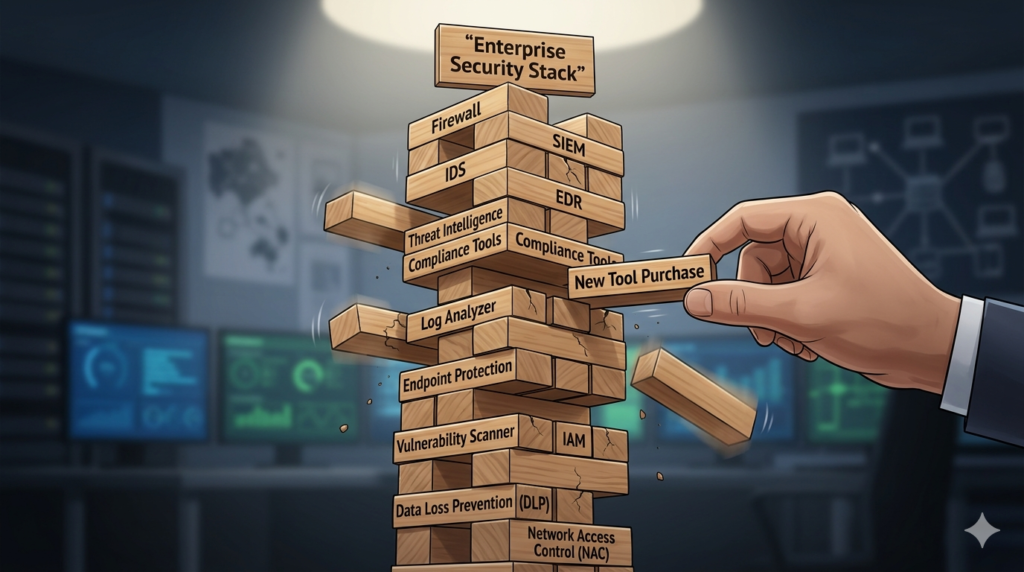
Imagine hiring ten different security guards for your office, each speaking a different language, watching a different door, and writing their incident reports in a completely different format.
Sounds chaotic, right? Welcome to the average enterprise security setup. Most organizations don’t run one security tool they run many. Enterprises commonly deploy combinations of:
| Firewalls | Intrusion Detection Systems | Endpoint Protection Platforms |
| SIEM Systems | Log Analyzers | Threat Intelligence Platforms |
The list goes on. And more often than not, each of these products comes from a different vendor, built on a different architecture, speaking a different technical language. Nobody designed this mess on purpose.
It just kind of… accumulates, one purchase at a time, usually driven by:
- A New Threat
- A Compliance Requirement
- A Convincing Sales Pitch
Research on security orchestration has consistently highlighted that organizations end up with heterogeneous solutions built on different technologies and paradigms, which are genuinely difficult to integrate and operate together.In plain terms, your security stack becomes a tower of incompatible pieces rather than a unified defense system.
STEP 2: TOOL SPRAWL CREATES ALERT FATIGUE
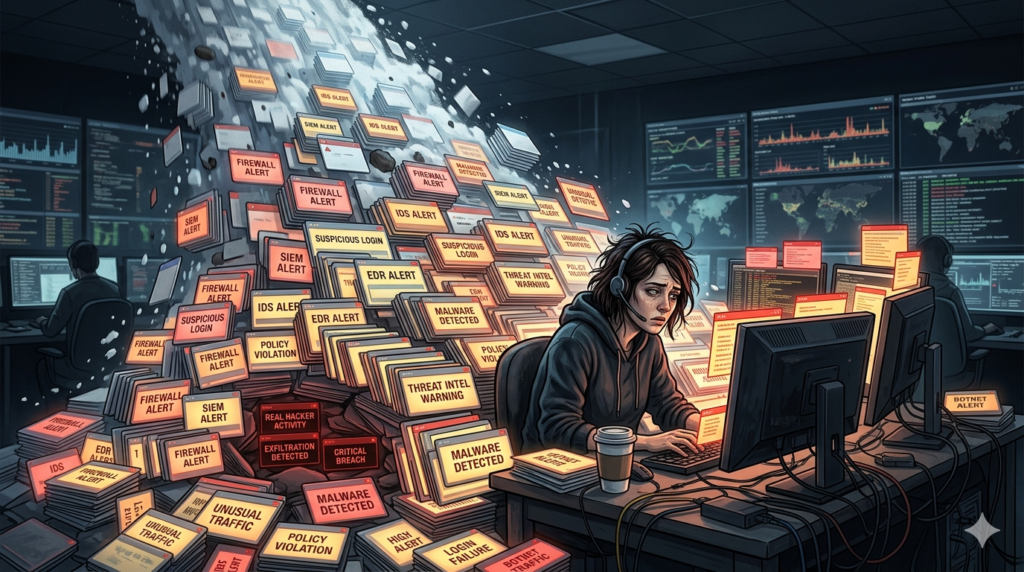
If tool sprawl is the disease, alert fatigue is the fever that follows. And just like a fever, it starts manageable a few notifications here, a few warnings there. Until suddenly your entire screen looks like a slot machine that never stops spinning.
Here’s the thing about deploying more security tools: more tools don’t just mean more protection, they also mean more noise, Each tool
- Runs on its own detection logic
- Watches its own corner of the network
- Raises its hand every time something looks remotely suspicious
When you have ten tools doing this simultaneously, they often end up flagging the same event ten different times in ten different ways. The alerts stack up fast and the numbers are genuinely staggering.
1) Some enterprises process hundreds of thousands of alerts every single day.
2) One large-scale study documented over 3.1 million alerts handled across just six months.
3) Another SOC reported more than 450,000 alerts per day during peak periods.
Now, the cruel irony is that the vast majority of these alerts turn out to be false positives or low-priority noise. But analysts can’t simply ignore them, because buried somewhere in that mountain of mundane warnings could be an actual attack. So they have to go through everything, every day, every single time because “JUST IN CASE”.
1) 54% of security teams feel overwhelmed by alert volume
2) Analysts burn roughly 27% of their time chasing false positives that lead absolutely nowhere
Over time, the human brain does what it always does under relentless, repetitive stress, it adapts by caring less. Analysts become desensitized. Critical alerts start to blend in with the background noise.
This is alert fatigue, and it’s not a personal failure on the analyst’s part, it’s a completely predictable outcome of designing systems that generate more signals than any human team can meaningfully process. Instead of hunting sophisticated attackers, most security teams spend the majority of their time closing tickets generated by their own tools.
STEP 3: ALL THESE TOOLS, YET THE BASICS ARE STILL BROKEN
So let’s recap where we are. Organizations are spending heavily on security tools, their analysts are drowning in alerts, and the overall system is crying under its own complexity. You would at least hope that all of this investment is keeping the actual attackers out, right? Well, here’s the uncomfortable part often, it isn’t. And the reason why is almost embarrassingly simple.
Most successful cyberattacks don’t rely on cutting-edge techniques or Movie-style hacking. They don’t need to. Research consistently shows that:
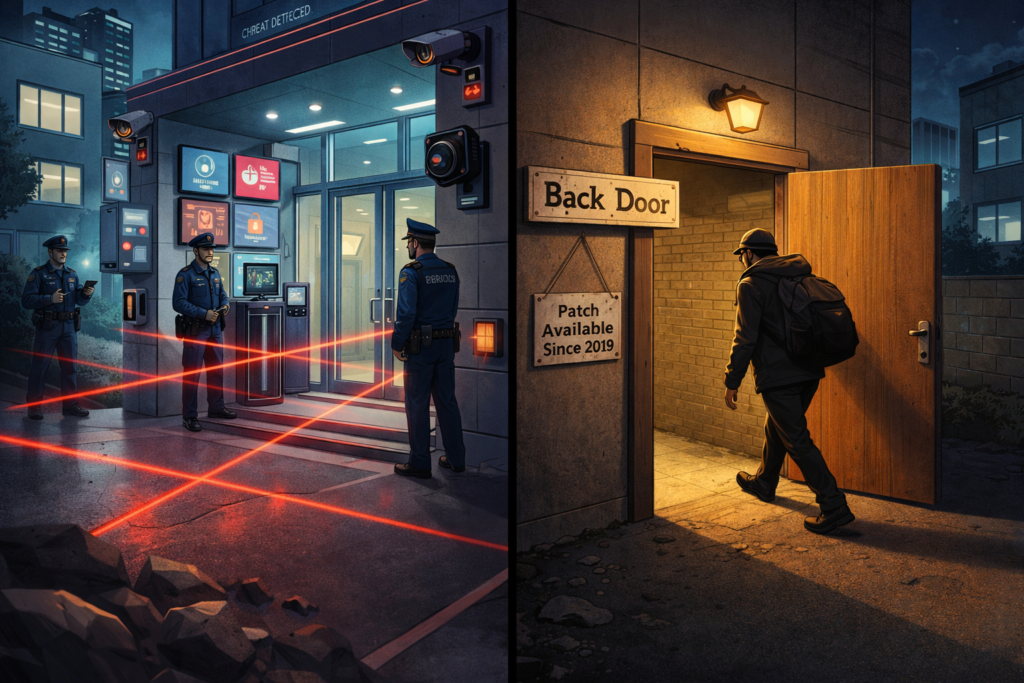
Around 90% of attacks exploit known vulnerabilities, weaknesses that already have fixes available. Even more humbling, nearly half of all attacks target vulnerabilities that are four to five years old.These aren’t zero-day exploits discovered by elite hackers working in underground bunkers. Think of it like this:
You’ve installed a state-of-the-art alarm system, hired a full security team, and set up cameras on every corner of the building. But the back door? Still unlocked. Has been for five years. An attacker without elite status comes and goes without you ever knowing.
The most telling sign of this comes from the analysts themselves. When experienced SOC professionals actually sit down to investigate an incident, their first instincts aren’t to fire up some advanced threat intelligence platform. They start with the basics:
- checking whether the affected system was properly patched
- looking at what ports and services are exposed
- running a basic vulnerability scan
These are foundational practices “Security 101” and they remain the most reliable starting point precisely because the basics are still so frequently missed.
CONCLUSION
The cybersecurity industry isn’t broken because the threats aren’t real, they absolutely are. It’s broken because fear became a more profitable product than actual security. Organizations keep buying the next shiny tool, analysts keep drowning in noise, and attackers keep walking through the same old unlocked doors while everyone’s busy watching the alarm dashboard.
The irony is almost poetic. At the end of the day, no amount of sophisticated software replaces patching your systems, managing your access controls, and doing the unglamorous basics consistently well. Security doesn’t have to be sold to you like a horror movie it just has to be practiced like a habit.
References
- A Multi-Vocal Literature Review of Security Orchestration : here
- That Escalated Quickly: An ML Framework for Alert Prioritization : here
- AACT: Automated Alert Classification and Triage : here
- AlertBERT: A Noise-Robust Alert Grouping Framework for Simultaneous Cyber Attacks : here
- Security Operations Center: A Systematic Survey : here