


OVERVIEW OF TRADITIONAL SECURITY MODELS
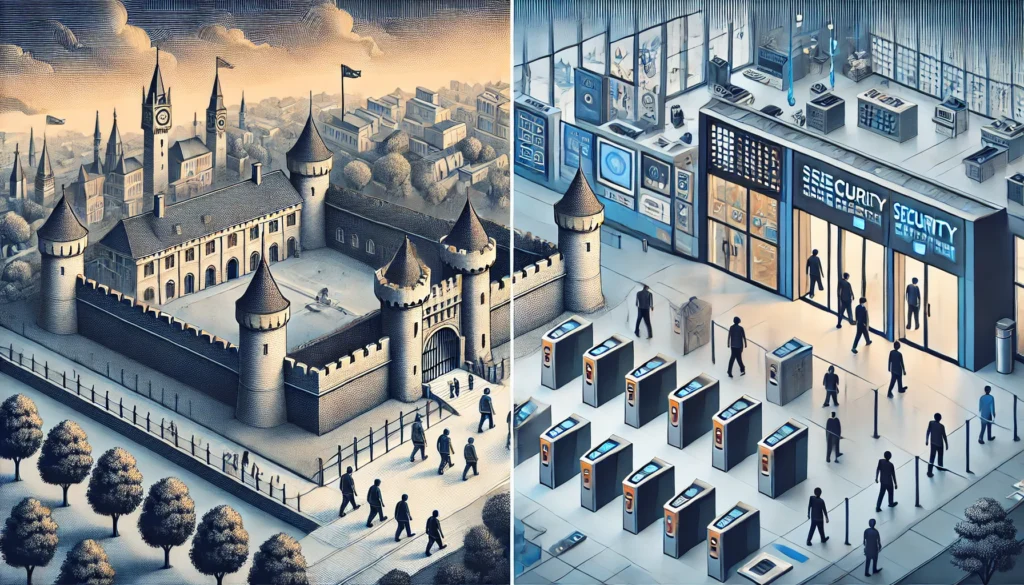
Traditional security models assume the internal network resembles a fortress with massive walls, moats, and watch guards pacing around the boundaries. A firewall is seen as the watch guard that protects the entrance to the fortress. All entities inside the perimeter are entirely trusted. The mindset is that within the network, you are safe. Think of the castle where the guards only screen people at the entrance gate. Once inside, you can get anywhere; it is a free-for-all.
THREAT LANDSCAPE
The threat landscape has dramatically changed. The cyber attackers of the present day have become very advanced in a way that beats external defences. Phishing, malware, and targets on software vulnerabilities will give an opening to the attackers and let them into the inner network, from which they would then move laterally to cause damage. This is equivalent to having an intruder who, once inside your castle, can access any room without additional checks
ZERO TRUST ARCHITECTURE
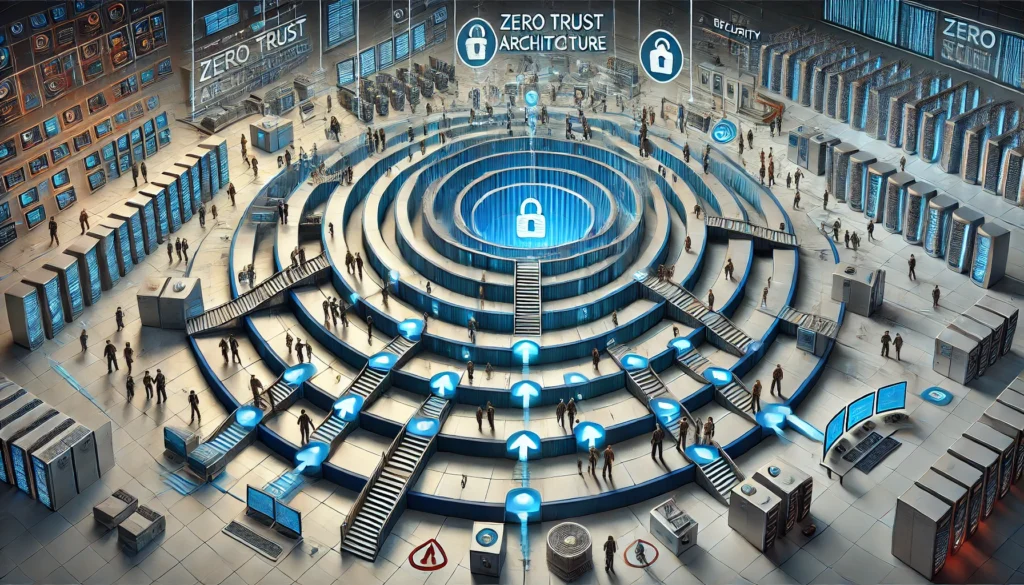
All these challenges or threats led to the Zero-Trust Architecture Model. Zero-trust is based upon never trusting and consistently verifying. In this model, by default, one is not trusted, whether a person is inside or outside the network. Any request to access the resource must undergo proper authentication and ensure continuous authorization and monitoring.
ZERO TRUST ARCHITECTURE
Zero Trust Architecture is an all-encompassing security model assuring that sensitive data and resources are protected strictly by validating every access request. ZTA does not inherently trust any threats, whether considered “external” or “internal.”
ZERO TRUST PRINCIPLES
1. EXPLICIT VERIFICATION
- Every access request must be verified through all available data points, including user identity, device health, location, etc. It is like asking for ID from everybody who is entering the office, even if they are the CEO
2. LEAST PRIVILEGE ACCESS
- The least privilege access is given to every user, meaning that it only grants enough authorization to meet the job requirement and does not give any more access than that. This also minimizes the potential harm/impact of any violation/attack. It would be like all the employees getting their own room with all the resources so they could get the job done without being able to access other parts of the building.
3. ASSUME BREACH
- Zero Trust Architecture operates under the assumption that an attack is already in place or has already occurred. It’s more of a philosophy of doing things in an active-proactive approach, looking at what’s happening and the capability to react to any anomaly.
COMPONENTS OF ZERO TRUST ARCHITECTURE
1. Identity Verification and Access Management
- Access should not be totally denied but instead rationed such that it should only be granted to a genuine user who has adequate justification after strict access controls and strong identity validation.
2. Device Security and Network Segmentation
- Ensure all devices are thoroughly secured and implement comprehensive network segmentation to effectively prevent the lateral spread of potential attacks within the network.
3. Continuous Monitoring and Real-time Threat Detection:
- Utilize sophisticated tools and technologies to maintain continuous monitoring and implement real-time threat detection, ensuring immediate identification and mitigation of potential security threats.
ZERO TRUST MODEL V/S TRADITIONAL SECURITY MODEL
| Aspect | Traditional Security | Zero Trust Architecture |
|---|---|---|
| Trust Model | Trust once inside | Never trust, always verify |
| Perimeter | Strong, fixed | Dynamic, adaptive |
| Access Verification | Initial login | Continuous verification |
| Security Focus | Network boundaries | Individual resources |
| Response to Breach | Reactive | Proactive |
TRADITIONAL SECURITY MODEL’S SHORTCOMINGS
Following are a few of the disadvantages of the Traditional security models:
1. IMPLICIT TRUST
- Right from the moment of entry of a user or a device into the network, this user or device is automatically trusted to act innocently within the network. An attacker can exploit trust to gain entry and move around the network without raising suspicion.
2. ABSENCE OF INTERNAL DEFENCES
- Traditional models predominantly focus on perimeter defences (firewalls, gateways) at the expense of internal security measures. This is like having a solid outer wall, but everything inside is built of haystacks.
3. STATIC SECURITY POLICIES
- Traditional security relies on static, pre-defined security policies that do not adapt to changing threats or environments. This rigidity makes it difficult to respond effectively to new and evolving cyber threats.
4. LIMITED VISIBILITY
- Security teams often lack comprehensive visibility into network activity and user behavior inside the network, making it challenging to detect malicious activities early.
5. LACK OF GRANULAR ACCESS CONTROL
- Traditional models typically do not provide fine-grained access control, leading to excessive privileges for users and devices. This increases the risk of insider threats and lateral movement by attackers.
6. SINGLE POINT OF FAILURE
- Perimeter-based security creates a single point of failure. Once the perimeter is breached, the entire network is vulnerable to attack.
7. INEFFECTIVE AGAINST MODERN THREATS
- Traditional security measures are often ineffective against modern threats such as advanced persistent threats (APTs), insider threats, and sophisticated phishing attacks.
8. SLOW INCIDENT RESPONSE
- The reactive nature of traditional security means that responses to security incidents are often slow, allowing attackers more time to cause damage.
9. INADEQUATE PROTECTION FOR REMOTE WORK
- With the rise of remote work, traditional security models struggle to protect users and devices outside the corporate network, leading to increased vulnerability.
While traditional security models have provided a foundation for network protection, their inherent shortcomings make them ill-suited to address the dynamic and sophisticated nature of today’s cyber threats. The reliance on implicit trust, static policies, and perimeter-focused defenses leaves networks vulnerable to a wide array of attacks. To effectively safeguard modern digital environments, organizations must adopt more adaptive, comprehensive, and proactive security approaches such as Zero Trust Architecture, which addresses these limitations and enhances overall security resilience.
CONCLUSION
In summary, traditional security models rely on trust within the network boundary, making them susceptible to sophisticated threats such as phishing and malware. Zero Trust Architecture (ZTA) tackles this issue by continually checking rather than unquestioningly trusting, guaranteeing that each access request is validated and consistently supervised. Key principles consist of verifying explicitly, granting minimum access privileges, and acknowledging that breaches will occur. ZTA employs identity verification, device security, network segmentation, and continuous real-time threat detection as part of its thorough strategy.