


The rise of blockchain was the dawn of a new era in decentralised, transparent, and secured ways of doing business. However, with the rise of the popularity of blockchain, the issue of scalability has also been raised because of its importance. Layer 2 solutions have become as important an innovation as Layer 1 ones. A result of Layer 2 solutions is more efficient handling of increasing numbers of transactions in blockchain networks. This research piece presents a general background and, more importantly, discusses the importance and benefits of Layer 2 solutions.
LAYER 2 SOLUTION
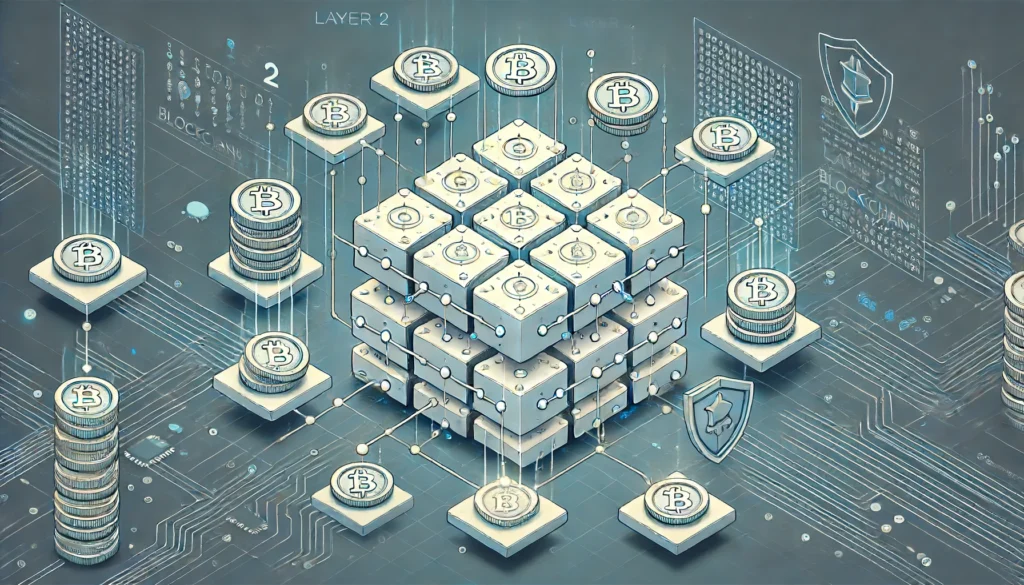
Layer 2 solutions are protocols or systems that exist over and above the existing blockchains (Layer 1) that increase the scalability and efficiency of the underlying blockchain. Suppose the Layer 1 solution changes the base layer of the blockchain (say, modifications of features like increasing the size of blocks or modification of the consensus mechanisms in Layer 1). In that case, the Layer 2 solutions work above the base layer. To explain in simple words, Layer 2 of a blockchain gives way to a significant upgrade without the changes in the central structure of the blockchain. Layer 2 solutions are the alternate frameworks working beside the main blockchain. They are off-chain, meaning Layer 2 solutions reduce the load on the main chain, and the transactions are cheaper and faster.
COMPARISON : LAYER 1 & LAYER 2
| Aspect | Layer 1 Solutions | Layer 2 Solutions |
| Definition | Modifications and improvements made directly to the base blockchain protocol. | Protocols built on top of the existing blockchain to enhance scalability and efficiency. |
| Scalability Approach | Increases capacity by changing the underlying blockchain protocol. | Offloads transactions from the main chain to reduce load and increase throughput. |
| Transaction Speed | Limited by block size and block time. | Significantly faster as transactions are processed off-chain. |
| Transaction Costs | Generally higher due to on-chain transaction fees. | Lower costs as most transactions occur off-chain. |
| Security | Maintains the same security model as the underlying blockchain. | Depends on the security model of the Layer 2 protocol but often relies on the Layer 1 chain for final settlement. |
| Decentralization | Fully decentralized as it operates within the main blockchain’s consensus mechanism. | Can vary, but generally aims to maintain decentralization by leveraging the Layer 1 blockchain for security. |
| Implementation Complexity | Requires changes to the base blockchain protocol, often needing consensus from the network. | Can be implemented independently without changing the underlying blockchain. |
| Use Cases | Improving transaction throughput, changing consensus mechanisms, increasing block size. | Enabling microtransactions, instant payments, scalable dApps, reducing transaction fees. |
| Examples | Bitcoin’s block size increase, Ethereum’s transition to Proof of Stake (PoS). | Payment channels (e.g., Lightning Network), state channels, sidechains, rollups |
CURRENT SCALABILITY ISSUES
- BITCOIN: Processes around 7 transactions per second (TPS). For this reason, during times of high demand, the network experiences congestion, which results in high transaction fees and low confirmation speeds.
- ETHEREUM: Processes between 15 and 30 transactions per second (TPS). This rate of speed generally presents issues similar to those faced by Bitcoin when applications and DeFi platforms grow.
Visa operates at an average of 1,700 transactions per second (TPS) and has a theoretical maximum capacity of 24,000 TPS, which is orders of magnitude above the current blockchain network TPS speed.
While bitcoin transactions are synonymous with monetary transactions, in the case of Ethereum, any data posted by decentralised applications (dApps) is considered a transaction, including interactions with smart contracts, token transfers, and all activities made with a dApp, exponentially increasing the number of transactions on the network over that of a payment system that merely handles money. The scalability of such blockchains is curtailed by their low transaction throughput, limiting mass adoption. As transaction throughput is very low, this scalability issue will require creative solutions to ensure that the technology of blockchain scales according to the ever-increasing demand of global users.
LIMITATIONS OF BITCOIN TRANSACTION PROCESSING
- CONSENSUS MECHANISM: PoW: Bitcoin uses a consensus mechanism based on PoW, which involves solving rigorous puzzles to validate transactions and create new blocks. This process is deliberately computationally intensive and time-consuming to ensure security and protect the network from attackers.
- BLOCK SIZE: A Bitcoin block is restricted to 1 MB in size. This implies that each block can hold only a finite number of transactions; hence, any extra ones have to wait until the next block. This directly limits the number of transactions it can process in a second.
- BLOCK TIME: Bitcoin takes around 10 minutes to create one block; in simpler terms, new blocks are appended to the blockchain every 10 minutes. With block size and time, Bitcoin allows only about seven transactions per second.
- SIZE OF TRANSACTIONS: Bitcoin transactions are voluminous, which is necessary given that inputs, outputs, and digital signatures have to be included in every transaction. This, in turn, limits the number of transactions that can be accommodated in one single block.

LIMITATIONS OF ETHEREUM TRANSACTION PROCESSING
- CONSENSUS MECHANISM: Like Bitcoin, initially, Ethereum used the consensus mechanism of Proof of Work (PoW) to secure its network. Moreover, PoW sets it up so that the transaction processing speed is the same. However, in its plans to enhance scalability in the network, Ethereum is steadily moving towards utilising a Proof of Stake (PoS) consensus mechanism with the upgrade to Ethereum 2.0.
- GAS LIMIT: A gas limit is in place to limit the computational work required for the transactions in a block. Therefore, the gas limit for each block restricts the number of transactions and smart contracts that can be processed within a single block. The current gas limit allows 15 to 30 TPS for Ethereum.
- TIME BETWEEN BLOCKS: The time is less than for Bitcoin, about 13 to 15 seconds per block, for Ethereum. The gas limit and the consensus mechanism restrict the processing capability.
- SMART CONTRACT EXECUTION: Ethereum is home to many extremely complex smart contracts, which necessitates more computational resources. Executing these contracts consumes gas and block space, reducing the number of standard transactions that can be processed in each block.
EFFECTS OF THESE LIMITATION
The limitations of both Bitcoin and Ethereum that are highlighted earlier lead to some severe consequences, which include:
- NETWORK CONGESTION: When Bitcoin and Ethereum experience high demand, their limited transaction throughput results in high network congestion. The network is congested because transactions take longer to mint, causing users to pay higher fees to prioritise their transactions.
- HIGH TRANSACTION FEES: High transaction fees might arise because users will compete to get their transactions included in the next block, rendering microtransactions and frequent transactions economically infeasible.
- BARRIER TO MASS ADOPTION: The scalability challenge hinders the mass adoption of blockchain technology. To support worldwide usage, blockchain networks need to be able to handle thousands of transactions per second with minimal delay.
ADVANTAGES OF LAYER 2 SOLUTIONS
Layer 2 solutions have a few key advantages that endow them with the solution to the scalability problems of Layer 1 blockchains:
- HIGH SPEED TRANSACTIONS: Due to the off-chain transaction process, Layer 2 solutions make transactions much faster. This reduces the time that would have been spent on the transaction confirmation.
- LOW TRANSACTION FEE: Transactions initiated from the off-chain through the use of Layer 2 solutions drastically reduce transaction costs. This is great for microtransactions and very frequent trading cases.
- SCALABILITY WITHOUT COMPROMISING: Although Layer 2 solutions improve the scalability of the blockchain, the security and decentralisation of the underlying blockchain are retained, ensuring that the blockchain remains secure and resistant to censorship, thus sticking to the basics of blockchain technology.
CONCLUSION
Layer 2 solutions are crucial in helping rectify the issues that have long plagued more basic blockchains. With an explosive increase in transaction speed, considerable cost reductions, and a higher level of scalability, the solutions clear the road for broader and deeper blockchain adoption. We’ll cover some of those in the coming parts of this series. So, we all are aware of Ethereum—one of the biggest known blockchain platforms with hefty quantities of smart contract utility and DApps. Still, it is undergoing severe scalability problems, transaction fees, and network congestion. That’s equivalent to developing extra lanes in a highway to allow more traffic to pass without developing the main road. Similarly, Layer 2 solutions can help address these challenges and maximise Ethereum mainnet potential through additional framework mechanisms.